Introduction
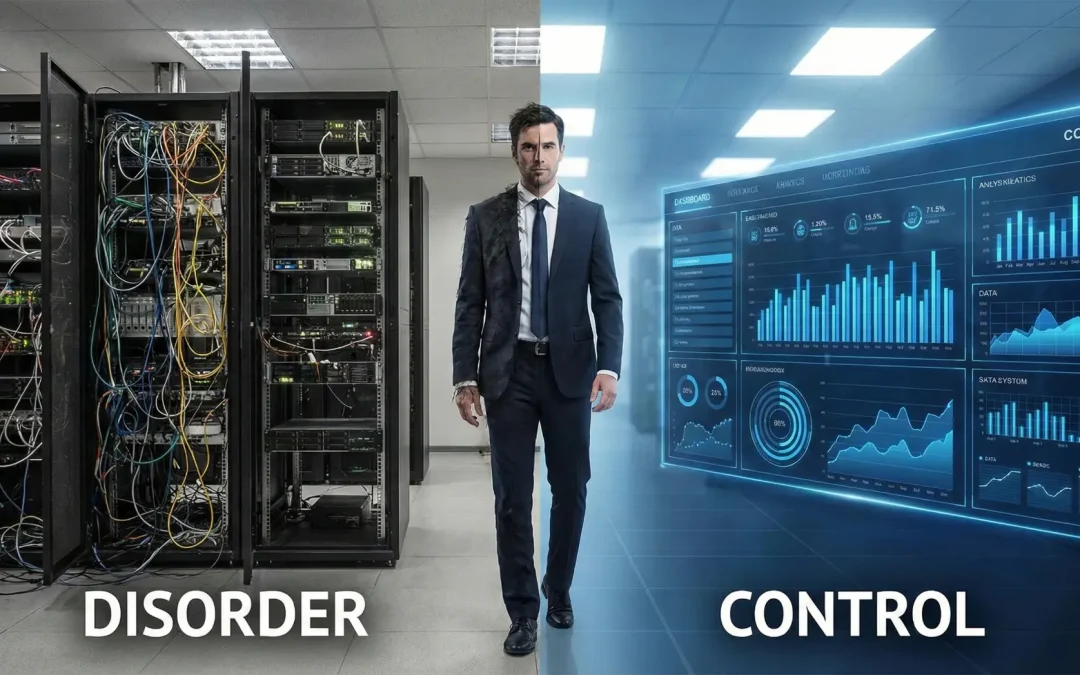
Regardless of company size, there is a reality that repeats itself time and time again: digital operations grow faster than control measures.
Systems added "to solve a specific problem," access rights that were never reviewed, processes that run only because someone knows the trick... until they stop running.
Many organizations assume that operational technology risks only affect large corporations. In practice, the most severe incidents occur in medium-sized companies that are operating well but lack a structured review of their technological environment.
1. Unchecked Technological Sprawl
One of the most frequent risks is the disorderly accumulation of technology. Over time, growing companies tend to accumulate:
- Old servers that keep running "by a miracle."
- Legacy systems that no one dares to touch.
- Duplicated applications.
- Licenses renewed out of inertia.
The problem isn't having many systems. The problem is not knowing exactly what is critical and what is not.
Real Impact: When something fails, no one is clear on dependencies, nor what can be safely turned off without affecting the business.
2. Excessive Access and Poor Privilege Management
This is one of the quietest risks... and one of the most dangerous. In many companies, we find:
- Users with more access rights than they need for their role.
- Accounts not deleted after an employee leaves.
- Logins shared "for convenience."
- Poorly defined roles.
Real Impact: Human error or a compromised account can affect entire systems without any control barriers.
3. Over-reliance on Key Personnel
Another critical operational risk is the concentration of knowledge (often called the "Bus Factor"). This happens when:
- Only one person knows how the core system works.
- No one else can restore a backup.
- Procedures are not documented.
In these cases, the company does not depend on technology; it depends on a single person.
Real Impact: Vacations, resignations, or unexpected absences can bring entire operations to a halt.
4. Backups That Exist... But Are Untested
Many companies believe they are protected because they "have a backup." The right question is: When was the last time data was successfully restored?
Common errors:
- Backups without periodic restoration tests.
- Copies stored in the same environment as the production system.
- Lack of isolation (immutability) against ransomware.
- No one is responsible for the entire process.
Real Impact: Discovering the backup doesn't work exactly when you need it most.
5. Lack of Monitoring and Early Detection
Without monitoring, problems are not prevented; they are merely endured. Many medium-sized companies operate blindly without:
- Clear performance or security alerts.
- Real-time visibility of incidents.
- Analysis of suspicious events.
- Response protocols.
Real Impact: Attacks are detected late, errors grow unchecked, and decisions are made under extreme pressure.
6. Security Based on Trust and Habit
This is a cultural risk, but a very real one. It is heard in phrases like:
- "We all know each other here."
- "Nothing has ever happened to us."
- "That only happens to big companies."
Trust is important for the team, but it is not a security strategy.
Real Impact: Internal and external threats are underestimated until a serious incident occurs.
7. Absence of an Incident Response Plan
When a serious problem occurs, many companies react like this:
- No one knows who to call.
- Technical solutions are improvised.
- Valuable time is lost in discussions.
A basic response plan does not prevent the incident, but it drastically reduces the impact.
Real Impact: Less downtime, less stress, and fewer financial losses.
Why do these risks affect growing companies so much?
Because they are in a difficult middle ground:
- Complex operations.
- Limited resources.
- Accelerated growth.
- Little structural review.
And because, often, the priority is to keep operating, not to stop and review.
The Right Approach: Management, Not Patches
These risks are not eliminated by buying yet another tool. They are reduced with:
- Diagnosis.
- Prioritization.
- Order.
- Guidance.
If your company has grown in recent years and has never conducted a structured review of its operational risks, it is likely operating with more exposure than you imagine.
At MDS, we help medium-sized companies identify, prioritize, and reduce real risks without disrupting operations or overspending.
📩 Schedule a strategic conversation and let's review the real state of your operation together.