
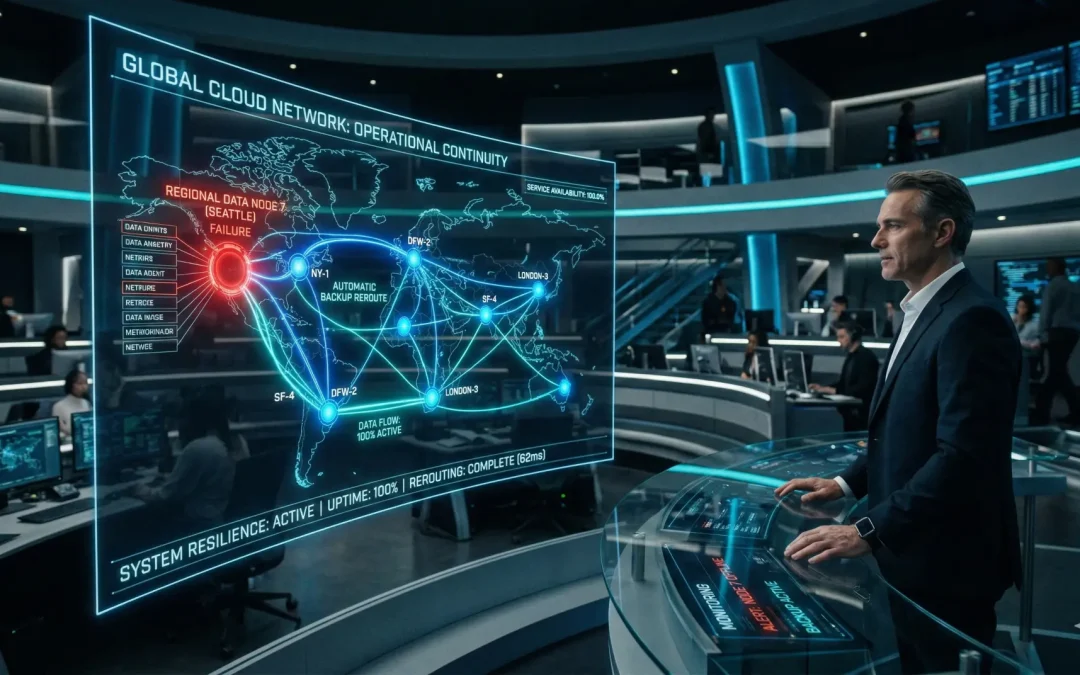
Introduction
In technology, the question isn't if your company will suffer an incident. The real question is: How long can it afford to be down?
In 2026, technological dependence is absolute. Sales, billing, logistics, internal communication, customer service... everything runs through digital systems. When these stop, the impact isn't technical, it is strictly financial.
Many companies migrate to the cloud seeking stability, but they make a common mistake: they believe that being in the cloud automatically equates to having cloud operational continuity.
It does not.
The cloud is a powerful tool, but continuity is the result of design, planning, and strategic management.
What is Operational Continuity, Really?
Having operational continuity doesn't just mean "doing a backup." It means that in the face of any adverse event (a cyberattack, human error, technical failure, or service outage), the business can:
- Continue operating with minimal friction.
- Recover quickly.
- Minimize financial impact.
- Keep customer trust intact.
The cloud greatly facilitates this scenario, but it does not guarantee it on its own.
The Myth: "Nothing goes down in the cloud"
It is true that major cloud providers (like AWS, Azure, or Google) offer incredibly high availability for their data centers. But the provider's availability does not cover:
- Configuration errors by your team.
- Accidental deletion of databases.
- Internal or external ransomware attacks.
- Bugs in your own applications' code.
- Poor initial architecture.
The core infrastructure might be up and running perfectly, but your operation could be completely down. The difference lies in the design.
Key Components of a Real Cloud Continuity Strategy
1. Redundant Architecture
A properly designed environment must include:
- Distribution across multiple geographic zones or regions.
- Replicated services.
- Elimination of Single Points of Failure (SPOF).
- Without redundancy, all risk is concentrated in one place.
2. Disaster Recovery Plan (DRP)
Just having backed-up data isn't enough. In a crisis, you must have defined:
- RTO (Recovery Time Objective): How many hours until we are back online?
- RPO (Recovery Point Objective): How much data can we afford to lose? (The last hour's transactions? The last day's?)
- Clear restoration procedures.
- Defined decision-makers.
- If these points aren't clear, recovery will be improvised chaos.
3. Tested Backups, Not Assumed Ones
In practice, one of the most common mistakes is failing to test restorations. An untested backup is a hypothesis, not a guarantee. Continuity demands:
- Periodic restoration tests.
- Data integrity validation.
- Isolation against cyberattacks.
4. Proactive Monitoring
Detecting a problem in minutes can mean the difference between a minor hiccup and a full-blown operational crisis. Cloud monitoring allows you to:
- Generate early warnings.
- Identify anomalous behaviors.
- Respond before the incident escalates.
The Financial Impact of Lacking Continuity
When a critical system stops during business hours:
- Direct sales are lost.
- Billing and collection chains are delayed.
- The customer experience is severely affected.
- Internal stress and pressure skyrocket.
- Brand reputation is compromised.
The cost per hour of downtime is usually much higher than management imagines. In many cases, reputational damage far exceeds the technical impact.
Warning Signs Your Cloud Continuity Needs Urgent Review
- A recovery plan has never been simulated or tested.
- Management does not know the actual restoration times (RTO).
- There is no formal documentation of the process to follow.
- The architecture was migrated "as is" from local servers without adding redundancy.
- You rely on a single IT person to restore the systems.
If any of these situations apply to your company, there is a dangerously high level of exposure that must be evaluated immediately.
Operational Continuity in 2026: A Standard, Not an Option
In a highly competitive environment, clients expect permanent availability.
The key questions for any steering committee are:
- If a critical incident occurs tomorrow, how long would we be out of operation?
- Do we have a clear, documented plan, or would we have to improvise on the fly?
Operational continuity should not be activated when a problem occurs. It must be designed long before.
At MDS, we help companies evaluate, design, and strengthen their operational continuity strategy in cloud environments, aligning infrastructure and security with business financial objectives.
📩 Schedule a strategic assessment and find out if your operation is truly prepared for any scenario in 2026.