Introduction
Not all technology service providers are created equal. The market is full of companies offering seemingly low rates, but when a critical hour strikes, they respond with a single, inexperienced technician. Others impose contracts full of "fine print" that tie your company down for years with no way out.
Choosing the wrong IT support provider can cost your company far more money (in downtime and data loss) than having no support at all.
The good news is that there are clear, objective criteria for evaluating a provider before you sign. These 7 key questions will help you separate the true strategic partners who protect your operation from those who just sell a false sense of security.
The 7 Filter Questions for Choosing Your IT Support Provider
1. How long does it take to respond to a real emergency?
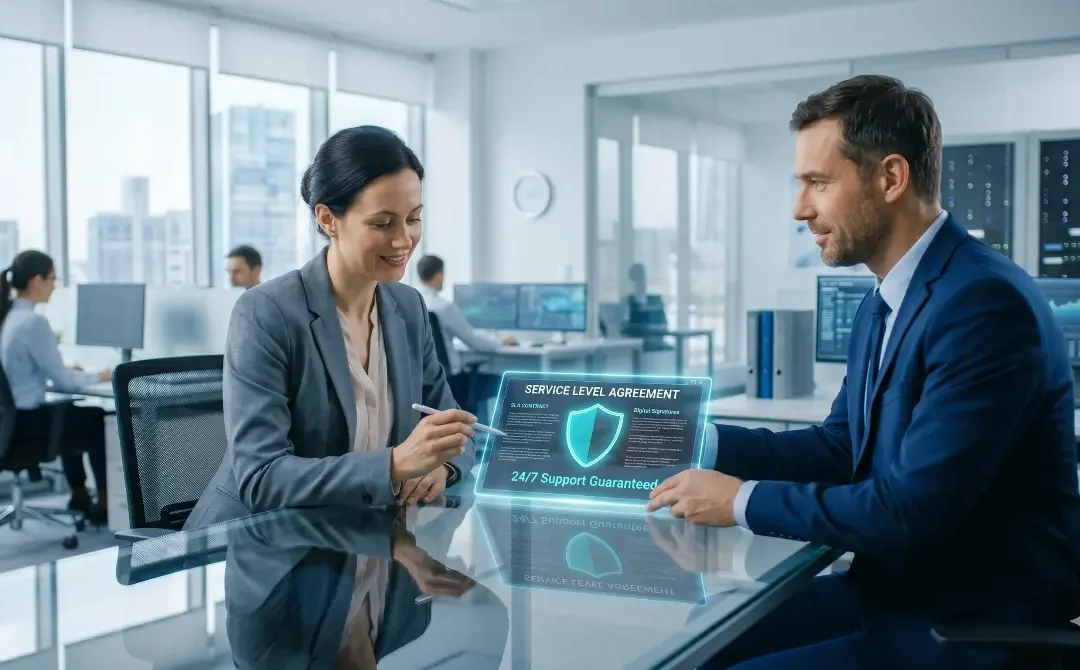
Response time is the most critical indicator. We are not talking about the time it takes them to answer the phone to say "we received your ticket," but the actual time it takes for a qualified engineer to start working on your problem. A professional Service Level Agreement (SLA) must specify differentiated times based on severity.
The trap question: "What happens if I call at 11:00 PM on a Friday because the main server won't boot?" The answer will reveal more than any sales brochure. At MobileData Solutions (MDS), we offer guaranteed 24/7 SLAs for critical incidents, with penalties if we fail to meet them.
2. What real technical certifications does your team hold?
Certifications aren't just a piece of cardboard on the wall; they are validated evidence from an external manufacturer that the technician knows what they are doing. Ask them to mention current certifications in Microsoft, AWS, Cisco, or cybersecurity (like ISO 27001 or CompTIA). Demand that the certifications belong to the actual team serving you, not just the agency's directors.
3. Do you include proactive monitoring or just "put out fires"?
There is a massive difference between a provider who waits patiently for you to call when your system crashes, and one who detects the failure hours before you even notice. Proactive monitoring uses tools to watch the network's health and generate automatic alerts. A 100% reactive model (based only on emergency tickets) is comfortable for the provider, but financially disastrous for you.
4. Do you have verifiable experience with companies my size?
IT support for a 10-person consulting firm is nothing like support for a 200-employee factory. The risk profiles, regulations, and tools are different. Ask for real case studies or references from current clients to reduce the learning curve.
5. What happens if I decide to cancel the contract?
This is the uncomfortable question many managers avoid asking. A transparent contract must detail the conditions for early exit, the absence of abusive penalties, and most importantly, the information transfer process. A reliable provider does not fear this conversation; a poor provider will try to evade it.
6. How do you document the infrastructure and changes made?
Documentation is the most valuable and invisible asset in IT support. If the provider doesn't log every IP, password, policy, or configuration in a professional logbook, your company is being held hostage. If they leave, they take all the knowledge of your own system with them. Demand a portal or dashboard where you can audit this information.
7. What exactly does the plan cover and what costs extra?
"Gray areas" in contracts are the leading cause of disputes. Does support include remote work (Home Office) equipment? Are Backup software and Antivirus included in the price, or billed separately? Demand an exhaustive list to avoid the typical answer: "that's evaluated on a case-by-case basis," which always ends in surprise invoices.
Comparison: Generic Provider vs. MDS
Response Time
❌ Generic IT Provider: Vague or no written guarantees.
✅ MDS: SLA defined and guaranteed by contract.
Certifications
❌ Generic IT Provider: Undocumented or expired.
✅ MDS: Certified technical team, constantly updated.
Monitoring Type
❌ Generic IT Provider: Reactive only (waiting for your ticket).
✅ MDS: Proactive 24/7 with system alerts.
Exit Conditions
❌ Generic IT Provider: Abusive clauses and data retention.
✅ MDS: Flexible, transparent, and ethical contracts.
Cost Transparency
❌ Generic IT Provider: Surprise billing for "extras."
✅ MDS: 100% defined scope from day one.
Conclusion: IT Support That Actually Protects Your Operation
Choosing an IT support provider is not a simple purchasing decision; it is a business risk decision. The right partner will reduce your operational costs and allow you to focus on leading your business. The wrong provider will cost you clients, money, and sleepless nights.
Use these 7 questions as your ultimate quality filter.
Are you considering switching providers? Schedule a 20-minute strategic call with us to learn how we structure IT support at MobileData Solutions.
📩 Contact us today: No aggressive commitments, no fine print. Just technology aligned with your business.