
Introduction
When a company decides to “invest in security,” it almost always starts with the tools: antivirus, firewall, backup, or cloud storage. The problem is that, without a prior cybersecurity assessment, this investment is often driven more by trends or fear than by the actual risk to the business.
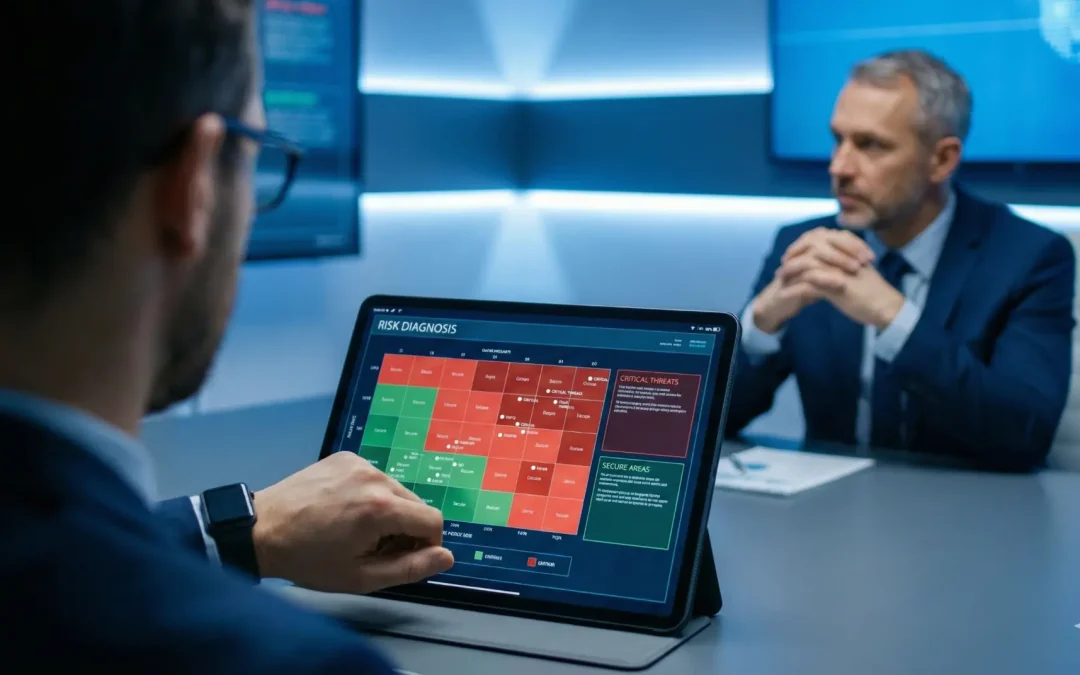
A cybersecurity assessment is not simply a bureaucratic formality. It is the crucial moment when the company understands its current situation and stops making decisions blindly.
Why many companies avoid assessments
From our experience in the field, the reasons for avoiding this step are usually the following:
- “We don’t want to be told everything that’s wrong.”
- “It’s sure to be very expensive.”
- “It will take up too much operational time.”
- “Our licensing provider already told us we’re fine.”
The reality is uncomfortable, but necessary: what isn’t assessed, isn’t managed.
What is a cybersecurity assessment really?
A well-conducted assessment doesn’t aim to scare; it aims to bring order.
This process includes:
- Identification of critical assets: Knowing where your key data, systems, and processes are located.
- Access and privilege review: Who has access to what?
- Business continuity assessment: Can you continue working if something fails?
- Exposure analysis: Detecting real, not theoretical, threats.
- Business impact: Evaluating the financial and operational damage, not just the IT damage.
It's not about "checking off items," but about understanding the consequences of failures.
The invisible risks that often appear
In real-world consulting, the most frequent findings are not usually complex, Hollywood-style technical failures, but management problems:
- Users with unnecessary access to sensitive information.
- Automatically configured backups that are never tested.
- Cloud services without cost control or perimeter security.
- Lack of clear accountability in case of incidents.
- Excessive dependence on a single person (the "know-it-all" systems expert).
These risks don't trigger red alerts on a dashboard, but when they fail, the impact on the company is total.
The true value for management
A thorough cybersecurity assessment allows you to:
- Prioritize investments: Avoid overspending on tools you don't need.
- Make data-driven decisions: Base decisions on facts, not assumptions.
- Justify budgets: Explain to management why the investment is necessary.
- Reduce operational and reputational risks.
Conclusion
If you can't answer these questions with certainty today:
- What exactly would happen if you lost your data today?
- How long would your operations be down?
- Who would make the critical decisions in the first 15 minutes?
Then you don't have true visibility into the risk.
👉 At MDS, we conduct cybersecurity assessments focused on business and decision-making. 📩 Schedule an initial assessment and start managing your risk with clarity.