Introduction
In many small and medium-sized businesses, the IT department grows purely reactively. What starts as basic support (someone fixing printers and setting up emails) ends up becoming a critical bottleneck for the entire operation.
When incidents pile up, response times lengthen, and dependence falls squarely on one person's shoulders, the problem ceases to be technical and becomes a structural business risk.
The Myth of the "Lone Wolf" IT Guy
Relying on a single internal technician, or a very small team, might seem cost-effective in the short term. However, it drastically limits your company's responsiveness, specialization, and scalability.
Modern technological infrastructures are complex and require multiple simultaneous competencies: cybersecurity, network management, user support, cloud architecture, and business continuity. It is humanly impossible for one person to be an expert in all of this 24/7.
5 Clear Signs of Technological Saturation
If your company is experiencing any of these situations, your infrastructure is holding back your growth:
1. High Response Times (Bottlenecks)
When an issue that should take minutes takes hours or days to resolve, the impact isn't just technical; it's strictly financial. Every minute of employee downtime affects productivity, halts revenue, and deteriorates the end-customer experience.
2. The "Putting out Fires" Syndrome (Reactive Approach)
The IT team arrives every day just to handle emergencies. Resolving incidents without the time to perform a root cause analysis guarantees that the exact same problem will happen again next week, creating a loop of stress and higher long-term costs.
3. Technical Debt and Pending Updates
A lack of patch management is the number one cause of ransomware incidents. Keeping systems and antivirus software updated is a basic practice, but overwhelmed teams lack the time and formal processes to do it.
4. Operational Blindness (Lack of Visibility)
There is no updated inventory of hardware, software licenses, accesses, or configurations. If you don't know exactly what's on your network, it's impossible to protect it, manage it, or budget for renewals.
5. Critical Dependence (Key Person Risk)
All the vital knowledge of the company is centralized in the head of a single employee. If that person gets sick, quits, or goes on vacation, key processes face an incredibly high operational risk.
What Does IT Outsourcing Actually Provide?
IT Outsourcing (Managed IT Services) isn't necessarily about firing your staff; it's about backing them up or delegating the operation to professionalize the department. This model allows access to a multidisciplinary team without incurring the massive costs of internal payroll, licenses, and continuous training.
A managed model guarantees:
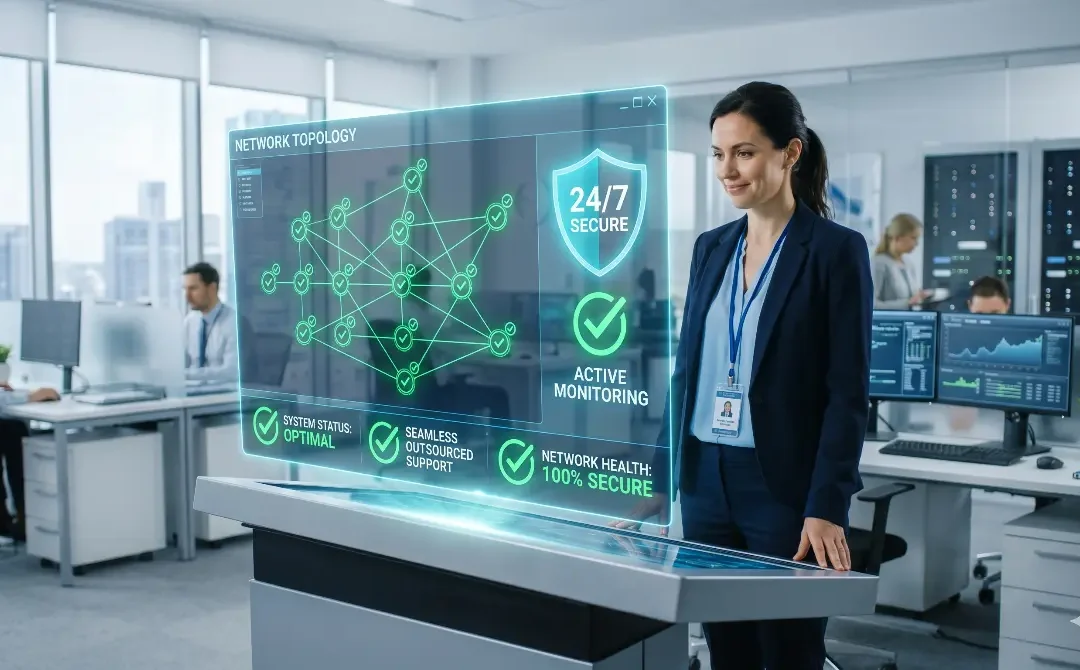
- Proactive 24/7 monitoring (detecting the failure before the user even calls).
- A structured Help Desk with SLAs (Guaranteed response times).
- Centralized cybersecurity and patch management.
- Standardized technical documentation.
- Immediate scalability if the company opens a new branch or hires more staff.
Conclusion
Various industry analyses show that outsourced models reduce downtime, improve operational efficiency, and turn surprise expenses into predictable, fixed costs.
If your IT team can't keep up, it's not a people problem; it's an operating model problem. Adopting IT Outsourcing allows you to move from a reactive, stressful operation to a technological strategy aligned with your business growth.
Is your infrastructure on the verge of collapse? Don't wait for a critical incident to halt your sales. At MobileData Solutions, we become your IT department or support your current team.
📩 Schedule a free diagnostic with us today and evaluate the real state of your technological infrastructure.